Category: Restaurant Technology | Read Time: 6 min | Author: ResButler Team.
If you’re running a busy restaurant in 2025, you’re probably juggling more software than you’d like to admit. A reservation platform here. A POS system there. A separate tool for events. Another for loyalty. Maybe a spreadsheet stitching it all together.
It works until it doesn’t.
The hidden truth about fragmented restaurant technology is that it costs you money every single day: in missed bookings, in manual data entry, in staff making judgment calls that a system should be making for them. And the busier your venue gets, the worse the problem becomes.
The solution isn’t more integrations. It’s an all-in-one system built from the ground up to manage your entire venue from a single database.
Here’s why that distinction matters more than most restaurant owners realise.
The Integration Illusion
When software vendors say their product “integrates” with your POS, what they really mean is that data gets passed between two systems that define core concepts very differently.
Take something as fundamental as a “table.”
- To your booking system, a table is a reservation slot with a party size and a time window.
- To your events system, that same table might be a cocktail-style stand-up setup with no fixed seating.
- To your QR ordering system, a table is an active session and an interaction point between kitchen and guest.
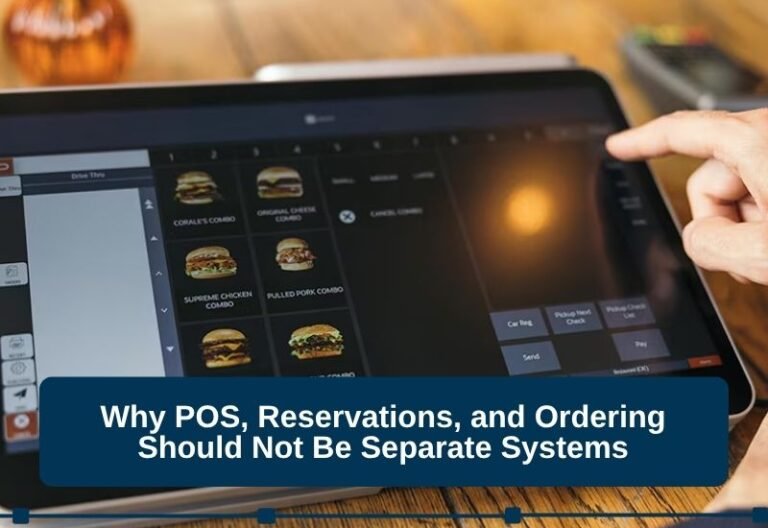
- To your POS, a table is a transaction container tied to a ticket.
- To your CRM, a table is barely relevant; it’s just metadata attached to a guest profile.
Four systems. Four different definitions of the same physical asset. And every time data crosses that boundary, something gets lost, delayed, or requires a human to intervene.
This is why integrations break down under pressure not because the software is poorly built, but because fragmented systems are fundamentally incompatible at the data level.
What “All-in-One” Really Means (and What It Doesn’t)
Many platforms claim to be all-in-one. In practice, most are a collection of modules bolted together over time through acquisitions or partnerships still running on separate databases, just presented under one login.
A genuinely unified system shares one live database across every function: reservations, functions and events, ordering, POS, kitchen display, CRM, marketing, loyalty, and reporting.
When a guest books a table online:
- The booking system confirms availability in real time.
- The floor plan updates automatically.
- The kitchen knows a dietary requirement is coming.
- The CRM records the guest’s preferences.
- Marketing captures the touchpoint for future campaigns.
No manual sync. No time lag. No staff member updated three systems because the computer couldn’t.
This is what WizButler’s patented Space & Time framework was built to model your entire venue as a living, real-time environment where every system speaks the same language.
The Revenue Case for Unification
The cost of fragmentation isn’t just operational friction it’s directly measurable revenue.
Missed bookings. A static, table-based booking system can only fill a slot if the entire time window is available for the entire table. But real venues are more complex. A booth that fits six might accommodate two separate parties back-to-back. A room that runs a private function in the morning can transition to standard service by evening. Siloed systems can’t model this. They reject bookings that a smarter system would accept.
Manual overrides. When your system can’t handle a situation autonomously, a staff member does it manually. Every override is time spent not serving guests. At scale, across a busy service, those minutes add up.
Reconciliation lag. At the end of the night, if your POS and your reservation data live in separate systems, reconciling the two takes time. You’re not getting clean, actionable insights you’re getting a best estimate pieced together from multiple exports.
One restaurant that moved to WizButler’s unified platform saw online bookings grow from 220 to 300 covers on a busy seating a 35% increase without any additional manual intervention. The system autonomously optimised the floor in real time, filling gaps that a static system would have left empty.
From Chaos to One Source of Truth
The most immediate practical benefit of a unified system is that your team stops doing data entry and starts doing hospitality.
When everything runs from one database:
- The front of the house doesn’t need to check three screens to understand what’s happening on the floor.
- Managers can pull reports without exporting, merging, or second-guessing data accuracy.
- Kitchen staff see orders from every channel QR, online ordering, and walk-in in a single KDS view.
- Marketing can segment guests based on actual visit behaviour, not imported CSV files.
The operational clarity that comes from a single source of truth compounds over time. You stop losing bookings you don’t know you’re losing. You stop paying staff to do what software should do. You stop making decisions based on incomplete data.
Who This Is Built For
Not every restaurant needs this level of sophistication. If you’re running a café with 12 tables and one seating per meal, a simple booking widget probably serves you well.
But if you:
- Run a high-volume venue with complex floor configurations
- Simultaneously manage regular dining service and private events
- Operate across multiple rooms, levels, or locations
- Find your team constantly overriding or manually adjusting the system
- Want real-time insight into revenue, occupancy, and guest behaviour
- then you’ve likely outgrown table-based, piecemeal software. And the cost of staying with it is higher than you think.
The Shift Is Already Happening
The restaurant industry is moving toward autonomous operations — not to replace hospitality, but to remove the decisions and repetition that shouldn’t require a human in the first place.
Seating optimization. Booking confirmations. Table transitions between functions and service. Order routing. Guest preference recall. These are problems software can solve so your team can focus on what actually builds loyalty: making guests feel genuinely cared for.
All-in-one isn’t a feature. It’s a philosophy that says your venue deserves a system that understands it as a whole, not a patchwork of tools that barely know each other.
Ready to See the Difference?
WizButler is the only platform built on a patented Space & Time framework, unifying every aspect of your venue under one operating system and one live database. From reservations and functions to ordering, POS, CRM, and marketing everything speaks the same language.
Book a Demo →See How Much Revenue You’re Losing .
WizButler (formerly ResButler) is an autonomous, AI-powered restaurant management system founded in Australia. It serves high-volume restaurants and venue groups looking to move beyond static, table-based software.